Loading...
Loading...
Loading...
Loading...
Loading...
Loading...
Loading...
Loading...
Loading...
Loading...
Loading...
Loading...
Loading...
Loading...
Loading...
Loading...
Loading...
Loading...
Loading...
Loading...
Loading...
Loading...
Loading...
Loading...
Loading...
Loading...
Loading...
Loading...
Loading...
Loading...
Loading...
Loading...
Loading...
Loading...
Loading...
Loading...
Loading...
Loading...
Loading...
The GR1D Network provides a comprehensive solution to the inherent challenges faced by on-chain intellectual property (IP) and game assets in the Web3 ecosystem. By addressing issues like distribution, interoperability, and user experience. GR1D simplifies the deployment and management of on-chain assets, driving mass adoption. Coupled with strategic partnerships with Amazon.com and Reddit.com, GR1D offers a seamless onboarding experience for mainstream users, creating a powerful foundation for the future of decentralized IP and gaming.
Distributing on-chain assets to mainstream audiences remains a challenge, as most Web3 platforms require users to navigate complex onboarding processes and engage with cryptocurrency, which can be off-putting to a mass-market audience.
GR1D’s strategic partnership with Amazon.com provides a frictionless distribution pipeline for Web3 products. Through Amazon, users can purchase digital credits using traditional payment methods like credit cards and easily redeem them for on-chain assets—without ever having to manage cryptocurrency or blockchain wallets. This trusted and seamless on-ramp makes it easier for users to claim, manage, and interact with on-chain IP and game assets.
Additionally, GR1D’s partnership with Reddit.com allows the onboarding of a multi-million+ digital avatar user base into the Web3 ecosystem. Through the GR1D Network, Reddit users can easily access blockchain assets through TERM1NAL, GR1D’s flagship multichain distribution platform. These partnerships create a smooth onboarding funnel, making the transition from Web2 to Web3 effortless for millions of potential users.
IP holders and game developers often face the issue of asset fragmentation, where assets are siloed on individual blockchains, limiting their utility across different games or platforms. This lack of interoperability creates friction for both users and developers.
GR1D is built with multichain interoperability at its core, allowing assets to seamlessly transfer between different blockchains. Using GR1D’s Mulit-Chain Asset Orchestration Layer (MCAO) IP and game assets become cross-chain compatible, enabling them to be used across a variety of platforms and ecosystems. This interoperability expands the utility and reach of digital assets, making them more valuable to both users and developers.
Managing on-chain IP and game assets can be complex for mainstream users, especially those unfamiliar with blockchain technology. The need to handle wallets, private keys, and on-chain transactions can discourage broader adoption.
GR1D abstracts away the complexities of blockchain with intent-centric architecture. This means that users can interact with on-chain assets without needing technical knowledge of the underlying blockchain technology. Features like social logins and one-click cross-chain transactions make the process seamless and user-friendly. Through partnerships with Amazon and Reddit, GR1D further simplifies onboarding by providing familiar Web2 experiences while connecting users to Web3 assets.
Token Standard
erc-20
Token Supply
1,000,000,000
Contract Address
Ethereum (Coming Soon)
Transferable
Yes
The beauty of this system is that it abstracts away the complexity of cross-chain operations. You don’t need to manually bridge tokens or write custom logic for every interaction across multiple chains—the Intent Layer handles it for you.
Below are some practical examples showing how you can use the intentLayer.processIntent() function to manage key operations like asset transfers, in-game purchases, and quest progress tracking.
Moving assets across chains is a complex task—bridging, syncing, and verifying all need to happen seamlessly. Here’s how the Intent Layer simplifies it.
The GR1D Asset Verification APIs provide a powerful tool for developers to verify user asset holdings on the Ethereum Mainnet & Solana Mainnet. These APIs support the verification of various assets, including ERC20 and ERC721 tokens on Ethereum and SPL Tokens and NFTs on Solana allowing for seamless integration into decentralized applications (dApps) and other blockchain-related services.
By utilizing the Gr1D Asset Verification APIs, developers can ensure accurate and real-time data retrieval for asset ownership, contributing to the overall security and reliability of their applications.
Staking $GRID on the network is done by done by converting $GRID to xGRID.
Staking is designed for participants who wish to stake on-chain and for node validator operators. The longer users stake $GRID, the higher their effective yield becomes. Stakers are encouraged to contribute to the network's growth, participate in governance, and engage in other essential activities, all of which can increase their yield of both xGRID and $GRID tokens.
When staking $GRID, users can convert it to xGRID at a 1:1 ratio at any time, with no penalties or unlock restrictions.
To convert xGRID back to $GRID, users must go through a redemption process that includes a customizable unlock period. The longer the unlock period chosen by the user, the better the conversion rate from xGRID to $GRID. The redemption rate increases in proportion to the time xGRID has been held, and every redemption results in a portion of xGRID being permanently removed from circulation.
The blockchain gaming industry has immense potential, but several key challenges stand in the way of its widespread adoption. These hurdles affect both developers and players, creating barriers that hinder growth and engagement in the ecosystem. GR1D Network provides a comprehensive solution, addressing each of these challenges to unlock the full potential of blockchain gaming.
Traditional blockchains struggle to handle the transaction volume necessary for large-scale gaming. This results in network congestion, high transaction fees, and slow performance, making it difficult for developers to build responsive, cost-effective games.
GR1D Network addresses scalability through a comprehensive, multi-layered approach, with L2 rollups as a central component. The network employs optimized data structures and advanced algorithms to reduce on-chain data storage and processing requirements, thereby enhancing efficiency. Additionally, network segmentation is used to strategically distribute traffic across the system, mitigating congestion and ensuring consistent performance across all network segments. GR1D also incorporates adaptive scaling mechanisms, allowing the network to dynamically respond to changing demand and maintain high performance even as the ecosystem grows.
A key element of GR1D’s scalability strategy is its diversified node ecosystem, which plays a vital role in sustaining the network’s operational efficiency. Validator nodes are responsible for ensuring the security and integrity of the L2 rollup infrastructure, providing the foundation for a reliable and secure system. Observer nodes improve data availability and network responsiveness by relaying critical information, contributing to the overall efficiency of the network. Meanwhile, orchestrator nodes manage the flow of transactions and data between Layer 1 and Layer 2, preventing bottlenecks and optimizing throughput. Together, these nodes serve as the scalability engines of the GR1D Network, ensuring its capacity to support high-volume, real-time decentralized applications at scale.
The lack of interoperability between blockchains leads to fragmented ecosystems, where in-game assets and digital items are confined to specific games or platforms. This limits cross-game interactions and restricts the utility of assets.
GR1D is built with multichain functionality at its core. Through our Multi-Chain Asset Orchestration Layer (MCAO), assets can be seamlessly transferred across different blockchains. This enables players to use their assets across multiple games and platforms, providing true cross-chain interoperability. This solution breaks down barriers between ecosystems, enabling a more connected and expansive gaming environment.
The technical complexity of blockchain gaming—such as managing wallets, private keys, and interacting with decentralized applications—creates a steep learning curve for mainstream gamers, discouraging mass adoption.
GR1D abstracts away the complexities of blockchain, providing a user-friendly experience. With features like social logins and one-click cross-chain transactions, GR1D makes it simple for users to engage with blockchain games without needing technical expertise. By improving accessibility, GR1D opens the doors for mainstream gamers to easily transition into Web3 gaming.
Technical limitations of some blockchains restrict game design and stifle innovation, limiting the diversity of experiences developers can create within blockchain environments.
GR1D’s modular architecture offers developers the flexibility and advanced tools they need to bring their creative visions to life without being constrained by blockchain limitations. By enabling scalable game mechanics and cross-chain asset integration, GR1D allows developers to push the boundaries of blockchain game design, resulting in more diverse and innovative gaming experiences.
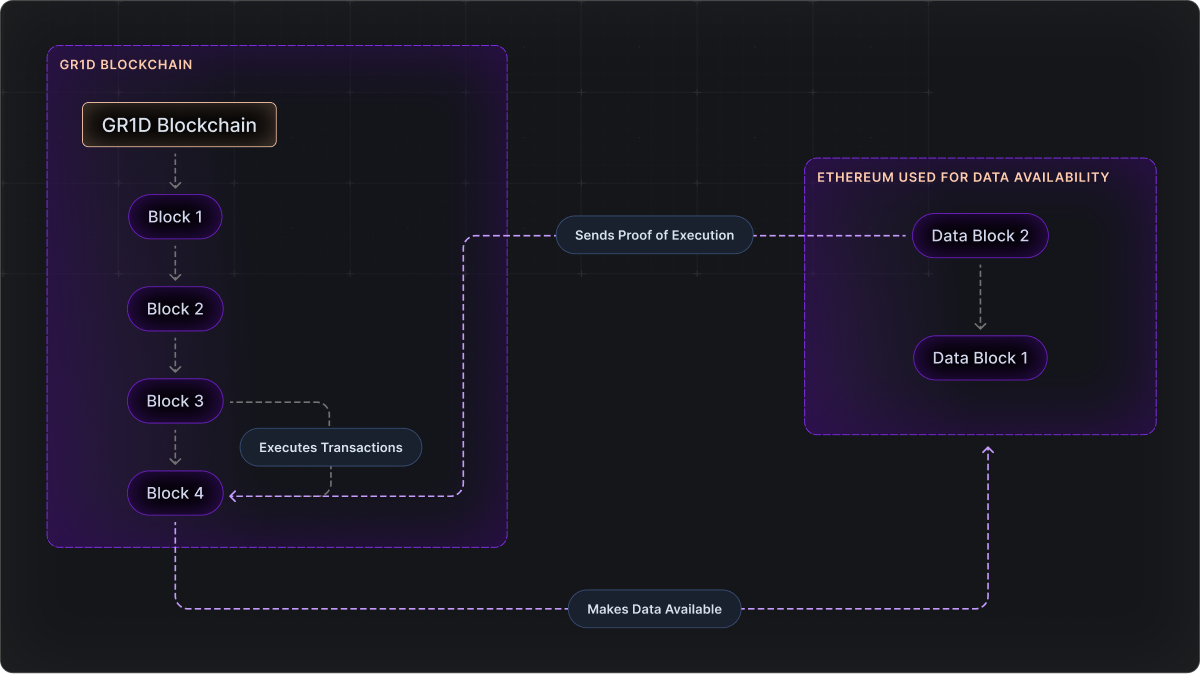
The GR1D Blockchain is a modular Layer 2 designed to enhance the scalability, efficiency, and interoperability of blockchain applications, particularly in high-demand sectors such as gaming and consumer-facing decentralized applications. By leveraging Optimistic Rollups, GR1D processes transactions off-chain, significantly reducing gas fees and improving transaction throughput. These transactions are then posted to Ethereum (Layer 1) for finality, ensuring that the network benefits from Ethereum's robust security while offering high-performance processing capabilities.
The GR1D Blockchain offers a powerful, scalable solution for decentralized applications by combining scalability, security, and developer flexibility, all while leveraging Ethereum's security. This layered architecture makes GR1D the ideal platform for the next generation of decentralized, consumer-facing applications.
Rewards and Emissions occur in the form of xGRID.
Network rewards and emissions are distributed to holders of xGRID tokens. Emissions are supported by network transaction fees, network payments, and all other forms of activity on the network.
GR1D Network's token incentive model ties emissions to the growth of activity in the ecosystem, rather than relying on indefinite user base growth. This strategic emission system serves to incentivize and enhance critical actions that maximize value creation.
For publishers and developers, emissions scale proportionately with the value they generate, serving as a powerful incentive to build within the GR1D Network. Passive holders of xGRID tokens also receive emissions. However, those actively driving value creation will always receive greater emissions.
This function takes in the assetId, sourceChain, targetChain, and recipient.
It creates an intent with all the relevant details, including the action 'TRANSFER_ASSET'.
The intentLayer.processIntent() function handles everything behind the scenes: bridging, cross-chain communication, and verification.
The response is handled using a Promise, ensuring you can react to both success and error states.
Sample Success Response:
Sample Error Response:
Handling in-game purchases across multiple chains—while also managing currency conversions—can get tricky. Here’s how the Intent Layer takes care of that complexity.
How it Works:
You provide the itemId, gameId, chainId, and the relevant currencies (userCurrency and itemCurrency).
The Intent Layer handles the token conversion and transaction across chains, ensuring everything completes smoothly.
If successful, you can update the player’s inventory or game state right after the transaction.
Sample Success Response:
Sample Error Response:
Syncing quest progress across multiple chains without losing data integrity can be a challenge. The Intent Layer keeps everything consistent, letting you focus on game logic.
How it Works:
This function takes the questId, taskId, and the relevant chainId where the task was performed.
Once the intent is processed, the Intent Layer ensures that the game state is updated consistently across chains.
You can trigger quest completion logic or achievement unlocks once the intent is successfully processed.
Sample Success Response:
Sample Error Response:
These examples show how GR1D’s Intent Layer abstracts the complexities of cross-chain operations, giving you a clean, high-level API to interact with. Whether you’re handling asset transfers, in-game purchases, or cross-chain quests, the Intent Layer takes care of the messy parts like token bridging, state synchronization, and verification.
function transferAsset(assetId, sourceChain, targetChain, recipient) {
const intent = {
action: 'TRANSFER_ASSET',
assetId,
sourceChain,
targetChain,
recipient
};
intentLayer.processIntent(intent)
.then(result => {
console.log('Asset transferred successfully:', result);
})
.catch(error => {
console.error('Error transferring asset:', error);
});
}{
"status": "success",
"transactionHash": "0x123abc456def789...",
"sourceChain": "ChainA",
"targetChain": "ChainB",
"assetId": "NFT-1001",
"recipient": "0xRecipientAddress123"
}{
"status": "error",
"message": "Insufficient gas for the transfer.",
"code": 402,
"sourceChain": "ChainA",
"targetChain": "ChainB",
"assetId": "NFT-1001"
}function purchaseItem(itemId, gameId, chainId, userCurrency, itemCurrency, amount) {
const intent = {
action: 'PURCHASE_ITEM',
itemId,
gameId,
chainId,
userCurrency,
itemCurrency,
amount
};
intentLayer.processIntent(intent)
.then(result => {
console.log('Item purchased successfully:', result);
// Update player inventory or game state here
})
.catch(error => {
console.error('Error purchasing item:', error);
});
}{
"status": "success",
"transactionHash": "0x789xyz123def456...",
"itemId": "ITEM-5678",
"amount": 100,
"userCurrency": "USDC",
"itemCurrency": "ETH",
"gameId": "GAME-42",
"updatedInventory": true
}{
"status": "error",
"message": "Failed currency conversion due to insufficient liquidity.",
"code": 503,
"userCurrency": "USDC",
"itemCurrency": "ETH"
}function updateQuestProgress(questId, taskId, chainId) {
const intent = {
action: 'UPDATE_QUEST_PROGRESS',
questId,
taskId,
chainId
};
intentLayer.processIntent(intent)
.then(result => {
console.log('Quest progress updated:', result);
// Check for quest completion or unlock achievements here
})
.catch(error => {
console.error('Error updating quest progress:', error);
});
}{
"status": "success",
"questId": "QUEST-9001",
"taskId": "TASK-2002",
"chainId": "ChainX",
"progress": "50%",
"achievementUnlocked": false
}{
"status": "error",
"message": "Failed to update quest progress due to chain sync issues.",
"code": 409,
"questId": "QUEST-9001",
"taskId": "TASK-2002"
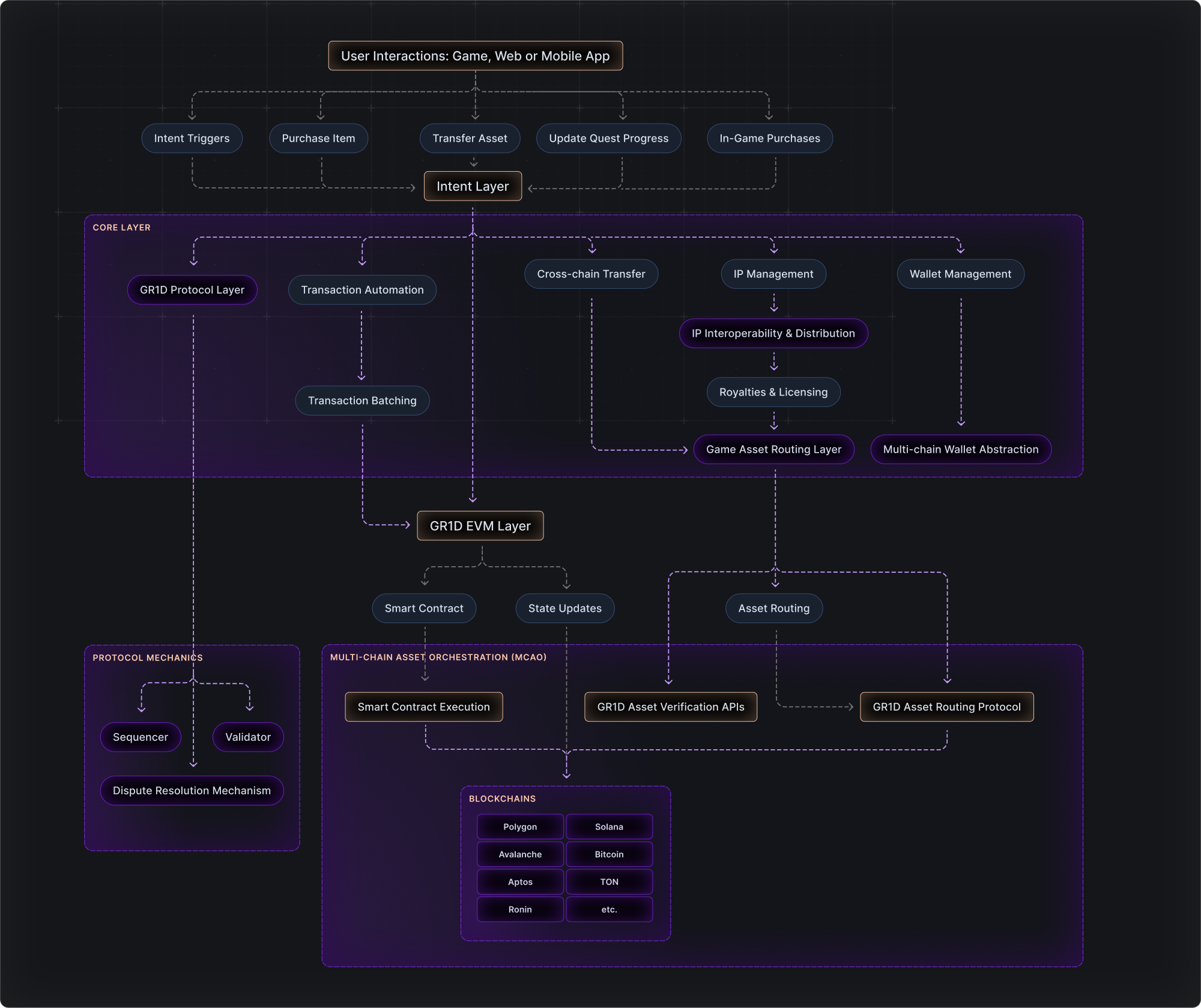
}The Intent Layer operates as an intelligent intermediary, translating high-level user intents into the specific low-level blockchain operations required to fulfill them. This translation process involves intricate coordination across multiple architectural layers, leveraging cutting-edge technologies to bridge the gap between user intent and its seamless execution.
Intent Capture and Validation: The Intent Layer captures user intents through a variety of interfaces, such as in-game actions, API calls, or in-game triggers. These intents are then validated against predefined schemas and security protocols to ensure their integrity and authenticity.
Circuit Nodes are the backbone of the GR1D Network, playing a critical role in transaction validation, cross-chain communication, scalability, and the execution of decentralized application logic. As GR1D aims to support a vast, decentralized application ecosystem, the role of Circuit Nodes is essential in maintaining the network’s integrity, scalability, and decentralized structure.
The GR1D Asset Verification APIs provide a powerful tool for developers to verify user asset holdings on the Ethereum Mainnet & Solana Mainnet. These APIs support the verification of various assets, including ERC20 and ERC721 tokens on Ethereum and SPL Tokens and NFTs on Solana allowing for seamless integration into decentralized applications (dApps) and other blockchain-related services.
By utilizing the Gr1D Asset Verification APIs, developers can ensure accurate and real-time data retrieval for asset ownership, contributing to the overall security and reliability of their applications.
Cross-Chain Routing and Orchestration: Once validated, intents are decomposed into a series of atomic operations that need to be executed across different blockchain networks. The Intent Layer leverages its modular architecture to intelligently route these operations to the appropriate chains.
Smart Contract Interaction: The Intent Layer interacts with smart contracts deployed on various chains to execute the necessary operations. This may involve transferring assets, updating a game's state, or triggering complex logic within the game or application.
State Synchronization: As operations are executed across multiple chains, the Intent Layer ensures that state information remains consistent across the network. This involves synchronizing data between different chains and resolving any potential conflicts that may arise.
User Feedback and Confirmation: Once the intent has been successfully executed, the Intent Layer provides feedback to the user, confirming the completion of the desired action. This feedback loop reinforces the user's sense of control and transparency.
Circuit Nodes function as powerful intent execution engines, translating high-level user actions into granular, low-level blockchain operations. This abstraction layer streamlines gameplay and enables the development of complex, cross-chain game mechanics.
Utilizing the MCAO protocol, nodes facilitate secure and seamless asset transfers and messaging across diverse blockchain networks. This empowers users to leverage their in-game assets across the entire Web3 gaming ecosystem, fostering a truly interoperable environment.
Circuit Nodes maintain and update the state of the GR1D Network, ensuring consistency and data integrity across all participating nodes. Consensus is achieved through a Proof-of-Stake (PoS) mechanism, where validators stake $GRID tokens to participate in block proposal and validation, ensuring the network's security and decentralization.
Circuit Nodes contribute to the network's scalability by handling a significant portion of the computational workload. Leveraging layer-2 technology and efficient data sharding, the network can process thousands of transactions per second, delivering a smooth and responsive gaming experience.
Nodes ensure data availability by storing and sharing transaction data and state updates with other nodes in the network. Robust security measures, including cryptographic verification and fraud proofs, safeguard the network from potential threats and malicious actors.
Source: Sepolia Testnet (L1)
Destination: GR1D Testnet (L2)
Choose your asset (e.g., Sepolia ETH or any ERC-20 deployed there).
Enter the amount and confirm the transaction.
Sign in MetaMask and let the bridge do its thing. You should see the assets on GR1D Testnet in a few minutes.
TERM1NAL is the flagship multichain application built on the GR1D Network, designed to showcase the full potential of interoperable, consumer-facing Web3 applications. As a groundbreaking distribution platform for game assets, intellectual property (IP), and digital assets, TERM1NAL allows users to seamlessly interact with content from multiple blockchains, facilitating a unified user experience. It serves as a crucial component of the GR1D ecosystem, demonstrating the power and scalability of multichain architecture to enable mass-market user adoption.
Visit TERM1NAL today at gr1d.gg
TERM1NAL allows users to claim and manage assets across multiple blockchains, simplifying the historically complex process of interacting with blockchain ecosystems. Whether a user is claiming in-game items, NFTs, or digital avatars, TERM1NAL enables seamless integration of assets from any chain, providing true cross-chain interoperability. This functionality not only benefits users but also empowers game developers and IP holders to distribute their assets across a diverse, decentralized ecosystem without limitations.
One of the core value propositions of TERM1NAL is the ability to interoperate gaming assets across different games and platforms. Assets claimed through TERM1NAL can be used in multiple games on multiple chains, breaking down the barriers between isolated ecosystems. This cross-chain interoperability is powered by GR1D’s multi-chain asset orchestration (MCAO) technology, ensuring that users can freely move and use their assets, creating a seamless and connected digital experience.
TERM1NAL has been engineered to simplify onboarding for both Web2 and Web3 users. For Web3-native users, TERM1NAL provides familiar tools to interact with decentralized applications (dApps) and assets. For Web2 users, TERM1NAL’s integration with partners like Amazon and Reddit makes onboarding frictionless, allowing users to purchase digital credits with traditional payment methods like credit cards and claim on-chain assets without ever needing to interact with cryptocurrency or blockchain complexity. This seamless funnel drives mainstream adoption by abstracting away the technical details of blockchain, letting users focus on their digital experiences.
Complexities of cross-chain interactions often hinder mass adoption, GR1D's intent-centric architecture prioritizes user experience and interoperability. By embracing intents as the fundamental building blocks of its design, GR1D is laying the foundation for a truly interconnected universal blockchain ecosystem, where users can effortlessly navigate a multitude of chains and applications without sacrificing simplicity or scalability.
Intents represent a profound shift in how we conceive of and interact with blockchain technology. They transcend the limitations of traditional transaction-centric models, allowing users to express their desired outcomes in a natural language and contextually rich manner. This abstraction of low-level blockchain complexities empowers users to focus on their goals, rather than the technical intricacies of achieving them.
Intents serve as the universal system of interactions in the GR1D network. They facilitate seamless communication and asset transfers across diverse blockchain environments, enabling users to engage with games and applications on different chains without encountering barriers. This fosters a truly interconnected gaming experience, where the boundaries between blockchains blur, and users can effortlessly navigate a multi-chain world.
GR1D is a modular, multichain network engineered to expand tomorrow’s mass-market consumer-facing applications. GR1D Network serves as the connective layer that links different networks together, enabling all kinds of apps and digital experiences to work seamlessly across platforms, and paving the way for the future of mass-market consumer applications.
GR1D is focusing on gaming initially as it represents the most mature and scalable entry point for consumer applications in blockchain. The gaming industry already boasts a large, active user base primed for digital ownership and cross-platform experiences, making it the ideal proving ground for blockchain’s potential. By starting with gaming, GR1D establishes the infrastructure and use cases needed to drive broader consumer adoption across various sectors.
GR1D's core utility lies in its ability to provide scalable, interoperable, and user-friendly infrastructure. With Layer 2 rollups and adaptive scaling mechanisms, GR1D handles high transaction volumes efficiently, ensuring cost-effective and real-time application performance. Its multichain interoperability enables seamless asset transfers and interaction across different blockchain ecosystems, expanding the functionality and reach of applications built on the network. Additionally, GR1D’s developer-friendly infrastructure offers tools that simplify the creation and deployment of dApps, while ensuring a smooth user experience that abstracts away blockchain complexities.
By leveraging strategic partnerships with platforms like Amazon and Reddit, GR1D enhances user acquisition and distribution, allowing Web3 products to reach mass-market users through frictionless onboarding and familiar platforms. This seamless integration of distribution channels helps bring blockchain technology to mainstream users while supporting developers with robust infrastructure and simplified deployment. Overall, GR1D provides a secure, scalable, and interoperable foundation for the future of consumer-facing decentralized applications.
By partnering with Reddit, GR1D Network has secured a direct channel to introduce millions of users to Web3, significantly expanding the potential user base for decentralized applications built on the GR1D Network. This strategic partnership enhances GR1D’s position as a leading infrastructure provider for consumer-facing applications, making it easier than ever for mainstream users to engage with blockchain-based technologies.
Through this partnership, GR1D is able to leverage Reddit’s user base and create a frictionless onboarding process for Web2 users. Reddit users, particularly those who engage with digital avatars, will be introduced to Web3 via GR1D’s seamless onboarding funnel. By integrating with ARENA, GR1D’s social onboarding platform and TERM1NAL, GR1D’s multichain distribution platform, these users can claim on-chain assets, interact with decentralized applications, and participate in the Web3 economy without needing prior blockchain knowledge.
The Reddit partnership is further strengthened by GR1D’s integration with Amazon for digital asset distribution. Through Amazon’s marketplace, Reddit users can purchase digital credits using traditional payment methods like credit cards and then seamlessly convert these credits into on-chain assets. This frictionless on-ramp eliminates the complexities of cryptocurrency, making it easy for Reddit users to transition into Web3 and claim digital assets, including NFTs and in-game items.
By onboarding millions of Reddit users, GR1D is not only growing its user base but also expanding the ecosystem of developers, game studios, and IP holders who can engage with these users. Reddit’s community of tech-savvy individuals and digital enthusiasts provides a fertile ground for the adoption of Web3 gaming, decentralized applications, and cross-chain asset interactions. Developers on GR1D will benefit from a large, engaged user base that is eager to explore new digital experiences.
GR1D maintains over 100 strategic partnerships across web3 and web2 to significantly enhance the value of the network for all stakeholders. Including a unique and strategic partnership with Amazon.com, securing an exclusive digital distribution pipeline for Web3 products. As well as a partnership with Reddit.com to onboard millions of their digital avatar users further into web3 through the GR1D network.
Learn more about GR1D Network Ecosystem at https://gr1d.network/ecosystem
The development of multichain applications unlocks new possibilities for blockchain technology, allowing for unprecedented interoperability and flexibility. With GR1D’s multichain infrastructure, users are no longer limited to a single blockchain ecosystem. Instead, they can seamlessly move digital assets, like NFTs or in-game items, across different platforms, applications, and chains. This creates a more connected experience where users can access a wider variety of services and use cases without the traditional barriers of isolated blockchains.
For developers, GR1D’s multichain architecture enables the creation of cross-chain applications that can scale to accommodate more users and higher transaction volumes. By leveraging multiple chains, developers can design applications that offer greater functionality, enhanced user experiences, and more versatile business models. This flexibility opens doors to creating interconnected digital ecosystems, where assets, data, and interactions flow smoothly between different blockchains, unlocking new revenue opportunities and expanding the reach of decentralized applications.
Additionally, by removing friction in cross-chain interactions, GR1D allows for simplified onboarding of mainstream users. This ease of use is crucial in bringing blockchain technology to the mass market, creating a pathway for users to engage with decentralized applications without being tied to one specific network or platform. Ultimately, GR1D unlocks a future where blockchain technology can support scalable, accessible, and interconnected applications for both developers and consumers.
0.8.26).With Hardhat:
With Truffle:
npx hardhat compilenpx hardhat run scripts/deploy.js --network gr1dTestnettruffle compiletruffle migrate --network gr1dTestnetGot your contracts deployed? Need to debug a transaction? Head over to the GR1D Testnet Explorer.
It’s your go-to for viewing transactions, inspecting smart contracts, and seeing token transfers in action. If something doesn’t look right, this is where you’ll find the details.
For those wanting real-time updates, you can connect via the WebSocket endpoint:
WSS URL: Perfect for monitoring on-chain events or listening for contract events like NFT mints or DeFi protocol actions.
Welcome to the GR1D Testnet! This is your playground to experiment, build, and deploy on the GR1D L2 Blockchain before moving your applications to mainnet. The GR1D Testnet is designed to simulate the full functionality of our Layer 2 (L2) rollup architecture, offering a realistic environment where developers can test smart contracts, bridge assets, and explore cross-chain capabilities.
Below, you’ll find all the essential details you need to get started with the GR1D Testnet.
The Solana Asset Verification API allows developers to verify whether a user holds specific assets on the Solana mainnet, including Solana Fungible Tokens (SPL Tokens) and NFTs. This API is essential for integrating asset verification into decentralized applications (dApps) and services built on Solana.
Asset Verification API for Solana
Endpoint:
Headers:
GR1D Network’s partnership with Amazon.com marks an industry-first milestone in how digital assets and Web3 products are distributed to mainstream consumers. This collaboration positions GR1D as the first and only Web3 platform to leverage Amazon’s digital distribution capabilities, allowing users to seamlessly purchase and access on-chain assets using traditional payment methods. By integrating Amazon’s globally trusted marketplace, GR1D removes the barriers typically associated with onboarding into Web3, offering a frictionless user experience that accelerates the mass adoption of blockchain technology.
Amazon’s marketplace reaches hundreds of millions of consumers worldwide, making it one of the most influential e-commerce platforms in existence. By securing a partnership with Amazon, GR1D is creating a direct pipeline for Web2 users to easily engage with Web3 assets and decentralized applications. This partnership plays a crucial role in bridging Web2 and Web3 by offering an easy, familiar entry point for users who may be unfamiliar with cryptocurrencies or blockchain technology.
GR1D’s integration with Amazon not only simplifies the process of purchasing and claiming digital assets but also validates the potential of Web3 products in mainstream consumer markets. By offering Web3 products on Amazon, GR1D taps into a vast, established retail distribution channel, ensuring that decentralized assets can reach millions of consumers without the typical hurdles of cryptocurrency exchanges or blockchain wallets.
The integration of Amazon with GR1D’s infrastructure allows users to purchase digital credits on Amazon.com using standard payment methods such as credit cards, bypassing the need to directly interact with cryptocurrencies. These digital credits can then be used to claim on-chain assets within the GR1D Network, making the process of acquiring digital assets as easy as purchasing any other product on Amazon. This streamlined process lowers the barrier to entry for mainstream users and accelerates Web3 adoption by offering a familiar and trusted transaction method.
GR1D’s partnership with Amazon creates a unique digital distribution pipeline for Web3 products. By leveraging Amazon’s e-commerce infrastructure, GR1D can offer Web3 products such as gaming assets, NFTs, digital collectibles, and intellectual property (IP) directly to consumers. These products are not only listed on a global marketplace but also backed by GR1D’s powerful multichain network, ensuring that the assets can be used across a range of decentralized applications and games. This distribution pipeline offers developers, game studios, and IP holders unprecedented access to millions of potential users, enhancing the reach and liquidity of digital assets on the GR1D Network.
One of the most significant barriers to Web3 adoption has been the complexity of acquiring and managing cryptocurrency. GR1D’s partnership with Amazon eliminates this obstacle by allowing users to buy digital credits with traditional payment methods. Once purchased, users can redeem these credits to claim on-chain assets through GR1D’s TERM1NAL platform, bypassing the need for cryptocurrency exchanges or wallets. This frictionless on-ramp makes GR1D the ideal platform for onboarding Web2 users into the decentralized world, as they can engage with blockchain-based assets without ever needing to interact with crypto.
GR1D Network Info - Testnet
Connect to GR1D Testnet
Bridge to GR1D Testnet
Deploy Contracts on GR1D Testnet
GR1D Explorer - Testnet
Building multichain applications that are scalable, user-friendly, and interoperable across different blockchain ecosystems presents a set of significant challenges that hinder widespread adoption. GR1D Network addresses these core problems head-on, providing a comprehensive infrastructure designed to make the development and deployment of multichain applications accessible to mass-market users. Here’s how GR1D solves the key challenges of building and scaling multichain applications:
Multichain applications often suffer from network congestion, high fees, and slow transaction speeds, limiting their ability to handle large-scale user activity—especially as user adoption grows.
GR1D Network approaches scalability with a comprehensive strategy designed to support consumer applications, with L2 rollups as a key component. The network employs optimized data structures and advanced algorithms to minimize on-chain data storage and processing, increasing efficiency for applications with high user demands. Additionally, network segmentation distributes traffic across different parts of the system, reducing the risk of congestion and ensuring smooth, consistent performance. GR1D also features adaptive scaling capabilities, allowing the network to adjust dynamically to fluctuations in demand, maintaining high performance even as user activity grows.
A crucial element in supporting consumer applications is GR1D’s diverse node ecosystem, which ensures the network's operational efficiency. Validator nodes uphold the security and integrity of the L2 rollup infrastructure, providing a secure foundation for consumer-facing apps. Observer nodes improve data availability and responsiveness by relaying essential information, enhancing overall network efficiency. Orchestrator nodes manage the flow of transactions and data between Layer 1 and Layer 2, preventing bottlenecks and optimizing throughput. Together, these nodes form the scalability backbone of the GR1D Network, enabling it to handle large-scale, real-time consumer applications with ease.
Lack of interoperability between blockchains creates isolated ecosystems, limiting the potential of multichain applications. Users and developers are confined to individual chains, restricting cross-chain asset and data interaction.
GR1D's multichain asset orchestration technology allows for seamless cross-chain asset transfers and communication between blockchains. Applications built on GR1D can interact with various blockchains, ensuring that assets, data, and functionality move fluidly across different networks. This interoperability enables a more connected ecosystem, expanding the utility of multichain applications and enhancing user engagement across platforms.
The technical complexity of managing multichain assets and interactions can be daunting for users, especially those unfamiliar with blockchain technology. Wallet management, private keys, and cross-chain operations often present significant barriers to mass-market adoption.
GR1D abstracts away the complexities of blockchain technology, providing user-friendly features like one-click cross-chain transactions, social logins, and simplified asset management. These tools make interacting with multichain applications easy and intuitive, allowing users to engage with decentralized technologies without needing deep technical knowledge. By improving accessibility, GR1D makes Web3 applications as simple to use as Web2 platforms, driving mainstream adoption.
Managing cross-chain transactions and data securely can pose significant challenges, especially in a multichain environment. Ensuring data integrity, consistency, and security across different networks is critical for user trust and application reliability.
GR1D utilizes state management and proof-of-stake consensus mechanisms to ensure that data is consistently updated and validated across all chains in the network. By implementing robust security measures, GR1D guarantees the integrity of transactions and data across multiple blockchains, providing a secure environment for both developers and users. This infrastructure allows for the safe and reliable execution of cross-chain applications, fostering trust and scalability.
Developing multichain applications can be technically challenging and time-consuming. Developers must manage different blockchain protocols, deal with complex integrations, and solve for scalability and cross-chain interoperability—factors that complicate the development process and hinder innovation.
GR1D provides a modular, developer-friendly infrastructure that simplifies the creation of multichain applications. With ready-to-use SDKs, built-in cross-chain tools, and modular architecture, developers can easily build, deploy, and scale their applications on GR1D. This streamlined development process reduces time-to-market and allows developers to focus on creating innovative user experiences without getting bogged down by technical constraints.
Getting users to adopt multichain applications often involves navigating the complexities of onboarding, particularly for non-crypto-native users who are unfamiliar with blockchain wallets and cryptocurrencies.
GR1D’s partnerships with Amazon.com and Reddit.com provide seamless onboarding and distribution for mass-market users. Through Amazon, users can purchase digital credits using traditional payment methods like credit cards and easily redeem them for on-chain assets, removing the need for users to interact with cryptocurrencies directly. With Reddit’s multi-million+ digital avatar user base, GR1D enables frictionless onboarding, making it easier for mainstream audiences to access Web3 applications. This unique distribution and onboarding funnel accelerates user adoption by integrating familiar Web2 processes with Web3 technologies.
The GR1D Network utilizes two tokens, $GRID and xGRID, to empower stakeholders and allow them to capture the value they create through immutable digital ownership. As the network scales and transaction volumes increase, token holders will benefit from rising demand and access a wide range of utilities offered by ecosystem participants, including developers and publishers of assets, intellectual property, applications, and services.
The $GRID token is essential to the GR1D Network, fueling transactions and empowering users. It grants holders governance rights and the ability to earn rewards through staking. $GRID also acts as a currency, facilitating payments for application, games and digital assets. Its cross-chain functionality enables seamless interoperability among multi-chain applications. Ultimately, all network activity strengthens the GRID token, driving value and solidifying its role as the foundation of the GR1D ecosystem. It will be fully transferable and tradable on both centralized (CEX) and decentralized (DEX) exchanges.
xGRID functions as a non-transferable asset that is minted to stakers, node operators, and network participants for performing key actions that drive network value creation.
The GR1D Network is designed to power scalable, secure, and user-friendly decentralized applications by providing a robust infrastructure that supports multichain interoperability and streamlined distribution. GR1D enables seamless interaction between different blockchains, creating an interconnected ecosystem for digital assets and consumer applications, particularly within gaming and Web3. Through strategic partnerships with platforms like Amazon and Reddit, GR1D simplifies user acquisition by providing frictionless onboarding pathways for mainstream users, while allowing developers to easily distribute Web3 products to mass-market audiences. Additionally, GR1D’s developer-friendly infrastructure facilitates the creation of dApps, providing a smooth and intuitive experience that abstracts away blockchain complexities, ensuring broad accessibility and widespread adoption.
Below are some core examples of how these network utilities are applied to Blockchain Gaming, On-Chain Intellectual Property, and the development of Milti-Chain Consumer Applications on the GR1D Network:
Blockchain GamingOn-Chain Intellectual PropertyMulti-Chain Consumer ApplicationsThe GR1D Network leverages a deflationary tokenomics model to align the interests of its community, counterparties, and the broader ecosystem while driving sustainable value for its native token. This model connects token utility directly to the demand for GR1D’s services, creating a self-reinforcing cycle of growth and scarcity.
In this system, counterparties such as businesses, gaming studios, and consumer-facing Web3 platforms engage with the GR1D Network and ecosystem to access essential network services. To utilize these services, counterparties must purchase GR1D tokens from the open market and stake them. The staked tokens act as collateral for the services to be rendered.
As the GR1D Network fulfills its commitments, the staked tokens are systematically burned. This burning mechanism permanently removes tokens from the circulating supply, reducing overall token availability. This design not only ties network utility to token value but also ensures that ecosystem activity contributes to the long-term value appreciation of the token.
The GR1D Network uses a decentralized proposal system to manage counterparty engagements and ensure alignment with the community. When a counterparty wants to use the network’s services, they submit a proposal outlining the work, required resources, and token pricing. The community reviews and votes on these proposals, deciding which partnerships to approve. This transparent process ensures that only valuable and well-aligned engagements proceed, while giving the community a key role in shaping the network’s growth.
The GR1D Testnet runs on a dedicated L2 network configuration and connects seamlessly with the Ethereum Sepolia testnet (L1). Here are the core parameters:
RPC URL: https://rpc-123420000418.raas-testnet.gelato.digital This is the endpoint for accessing the GR1D Testnet via HTTP for executing smart contract calls, managing accounts, and interacting with the network.
WebSocket URL (WSS): wss://ws-123420000418.raas-testnet.gelato.digital For real-time event listening and updates, connect via this WebSocket endpoint.
Explorer: GR1D Testnet Explorer A Blockscout-based blockchain explorer tailored for the GR1D Testnet, providing visibility into transactions, contract addresses, token transfers, and more.
Bridge URL: Use this bridge interface to transfer assets between Ethereum Sepolia (L1) and the GR1D Testnet (L2).
The GR1D Testnet rollup is set up with the following configuration parameters, ensuring consistent performance and stability:
Block Time: 2 seconds
L1 Chain ID: 11155111 (Sepolia)
L2 Chain ID: 123420000418 (GR1D Testnet)
Gas Limit: 30,000,000
Batcher Address:
The following are the smart contract addresses deployed on the GR1D Testnet for managing various system functions, such as bridging, configuration, and cross-domain messaging:
L1 Contract Addresses (Sepolia)
ProxyAdmin: 0x221A32055dF050C7E0592707238b6437D8eA4b52
SystemConfig: 0x767f21d40099eEcdAAeA71e812DB12004A7E0fc2
AddressManager: 0x9679B1E429A8356EEe971BCFF4d36F6208002468
L1ERC721Bridge: 0x555b1adB1c72D0b5Fa2a2d81483245478247e001
L2OutputOracle:
OptimismPortal:
L1StandardBridge:
L1CrossDomainMessenger:
OptimismMintableERC20Factory:
Batcher on L1: Batcher Address on Sepolia The batcher handles the bundling and submission of transactions from L2 to L1, ensuring efficient transaction processing and state updates.
Proposer on L1: Proposer Address on Sepolia The proposer is responsible for submitting state roots from the L2 chain to L1, ensuring the chain remains verifiable and synchronized.
Authorization: <GR1D_API_KEY> (Contact [email protected] to get early access)
Content-Type: application/json
Request Body:
owner_address: The Solana address of the user whose asset holdings are being verified.
token_mint_address: The mint address of the Solana Fungible Token or NFT.
Sample Response:
status: HTTP status code (200 indicates success).
message: A message indicating the result of the query.
data:
owner_address: The Solana address queried.
asset.balance: The number of tokens or NFTs the user holds.
asset.QueryResult: A hexadecimal string representing the encoded query result.
In the event of an error, the API will return a response with the appropriate HTTP status code and an error message. Common error codes include:
400: Bad Request - The request parameters are invalid.
401: Unauthorized - The GR1D_API_KEY is missing or invalid.
404: Not Found - The specified token_mint_address or owner_address is invalid.
500: Internal Server Error - An unexpected error occurred on the server.
API Key Management: Ensure that the GR1D_API_KEY is kept secure and never exposed in client-side code or public repositories.
Data Integrity: The query results are verified to ensure data integrity.
Rate Limiting: Be aware of any rate limits imposed on the API to prevent abuse and ensure fair usage.
Solana Fungible Token Verification:
Expected response: The balance field will indicate the number of Solana Fungible Tokens held by the user.
Solana NFT Verification:
Expected response: The balance field will indicate the number of NFTs held by the user.
No Asset Held:
Expected response: The balance field will be 0, and the QueryResult will reflect that no assets were found.
Let’s dig into why intents are such a critical piece of GR1D’s design. If you’ve worked with traditional blockchain models, you know they focus heavily on transactions and the technical specifics of each operation—things like bridging assets or syncing data between chains. That’s fine for developers, but for users, it can make the experience feel clunky, especially in a multichain ecosystem. This is where GR1D’s intent-centric architecture flips the script.
In the GR1D Network, intents act as the universal language that the network understands. They abstract away all the underlying complexities of cross-chain operations, allowing users to interact with the system in a straightforward, context-driven way. Instead of dealing with the technicalities (like picking the right bridge or managing different tokens across chains), users simply express their desired outcomes—things like “transfer this digital collectible from Chain A to Chain B” or “purchase chain A asset from chain B with 1-Click” GR1D’s Intent Layer then takes care of all the heavy lifting behind the scenes. Simplifying the execution of any complex use case.
Think of intents as an abstraction layer that shields users and developers from the intricacies of cross-chain interactions. Users don’t need to worry about what’s happening under the hood—they just specify their intent, and GR1D handles the rest. This is huge for developers too. It means you don’t have to write specific code for each chain interaction, which frees you up to focus on building engaging and user-friendly applications. By simplifying the development process, GR1D allows you to create apps that are not only accessible but also scalable, drawing in a larger audience without the friction typically associated with blockchain tech.
Now, when we say “seamless interoperability,” we mean it. The Intent Layer is what makes this possible. It acts as the bridge (no pun intended) that lets users move assets, interact with applications, and perform actions across multiple chains without hitting technical roadblocks. For example, when a user initiates an action like “send this token from Chain X to Chain Y,” GR1D’s intent system steps in, managing everything—asset transfer, cross-chain communication, and verification—so the user doesn’t have to think about any of it.
For developers, this is a game-changer. You can build applications that span multiple networks, creating interconnected experiences that feel unified, even if they rely on different blockchains behind the scenes. This opens up a lot of possibilities for building immersive, cross-chain games and dApps that wouldn’t be feasible in a traditional, siloed blockchain environment.
But it’s not just about making things easier for users and developers—intents are also a key part of GR1D’s strategy for scaling efficiently. The Intent Layer automates the processing of these high-level commands, which allows the network to manage complex interactions and high transaction volumes without breaking a sweat. This setup ensures that, as the GR1D ecosystem expands, the network remains fast and responsive, even when processing thousands of transactions or managing multiple cross-chain operations simultaneously.
For developers, this means fewer worries about performance bottlenecks or latency issues. GR1D’s architecture is designed to grow with the demand, meaning your applications can scale smoothly without requiring constant tweaks to handle increased traffic. You build it once, and the network handles the scaling, so you can focus on enhancing functionality rather than troubleshooting infrastructure.
How to Run a Circuit Node
Grid lets you contribute compute to the network by running a Circuit Node and delegating your Node License to it via a job execution wallet. Follow the steps below to get started.
Prerequisites
Before starting, ensure you have:
Docker installed (on Linux, Mac, or Windows)
A wallet address that owns node licenses (used in the OWNERS_ALLOWLIST
This encapsulates not merely the movement of assets but their true interoperability across a multitude of chains, brands, games, and applications, conducted by the intent-driven architecture of GR1D.
The Imperative of Breaking Down Barriers
Blockchain technologies face a fragmentation crisis. New blockchains emerge almost daily, each with its unique strengths and tradeoffs. Consumers are confined to isolated ecosystems, company branding campaigns are stuck, and everyone's digital assets are trapped within the walled gardens of individual chains. MCAO is GR1D's answer to this challenge, unlocking a future where game assets and brand experiences flow freely, transcending the limitations of individual blockchains.
$GRID and xGRID tokens serve distinct and separate roles within the Network. A core distinction is that $GRID is transferable and xGRID is non-transferable.
Service Collateral and Deflation: $GRID tokens are purchased and staked by counterparties as collateral to access GR1D’s services. As services are rendered, staked tokens are burned, directly linking token utility to network activity while reducing total supply. Network Fuel: $GRID will be the primary token used for all transactions and network operations, similar to how gas fees function on other blockchains. This ensures smooth and efficient operation of the GR1D ecosystem.
Governance: $GRID holders will have a voice in the future development of GR1D. They can participate in governance proposals, shaping the direction of the network and its features.
{
"owner_address": "6jm9hBqmTxb1KMHdu88YBtLZzipLLccNDadAeMYeEF5d",
"token_mint_address": "BfGBv5n9YoJBNudqNwBZMyqMsHwNreyLTb7BWQR6SXCp"
}{
"owner_address": "6jm9hBqmTxb1KMHdu88YBtLZzipLLccNDadAeMYeEF5d",
"token_mint_address": "BfGBv5n9YoJBNudqNwBZMyqMsHwNreyLTb7BWQR6SXCp"
}POST https://alpha.gr1d.network/api/ccq-svm{
"owner_address": "6jm9hBqmTxb1KMHdu88YBtLZzipLLccNDadAeMYeEF5d",
"token_mint_address": "BfGBv5n9YoJBNudqNwBZMyqMsHwNreyLTb7BWQR6SXCp"
}{
"status": 200,
"message": "Assets Fetched Successfully",
"data": {
"owner_address": "6jm9hBqmTxb1KMHdu88YBtLZzipLLccNDadAeMYeEF5d",
"asset": {
"balance": 5,
"QueryResult": "9e621d04b95250c5c6540568987b208b7856422e704edbffe3c43846df20115d553ebfc0f7f04824ab5db898e6c8116411584c40947b632f10789ee7de02d53c0500000000000000000000000000000000000000000000000000000000000000000000000000000000000000010000000000000000000000000000000000000000000000000000000000000000000000000000000000000000000000000000000000000000"
}
}
}Enable a user to transfer items and use them on any chain. MCAO enables frictionless asset bridging, verification of ownership, and updates to in-game inventories across chains.
A gamer's identity, achievements, and progression across all chains. MCAO empowers a unified player profile, where accomplishments and digital collectibles are aggregated from various gaming experiences.
During peak usage, blockchains experience congestion, impacting transaction performance. MCAO can intelligently distribute computational load across multiple chains, ensuring a smooth and responsive experience for all players.
Imagine a massive esports tournament where players compete across different blockchain-based games, their skills and assets contributing to a unified leaderboard. MCAO enables the tracking of player performance, validation of asset ownership, and secure distribution of rewards across multiple chains.
MCAO facilitates the creation of interconnected game economies, where in-game currencies and assets can be exchanged and utilized across different games and blockchains. This creates a vibrant and dynamic system, where the value of digital assets is amplified by their cross-chain utility.
Game servers can be distributed across multiple chains, leveraging the unique capabilities of each network to optimize performance and reduce costs. MCAO ensures seamless communication between game clients and servers, regardless of their underlying blockchain.
We view the entirety of the internet as a game, whose potential we have only begun to tap into. With our technology, a game isn't limited by its digital “four walls.” We can create interconnected experiences across social platforms where assets trigger unique rewards, scavenger hunts and quests. Enabling new partnerships for our game developers and providing engaging mechanics that create fun for gamers and new acquisition funnels for games.
Cross-Chain Interoperability: $GRID will facilitate seamless asset transfers and communication across different blockchain networks, enabling true interoperability within the Web3 gaming landscape.
Network Liquidity: $GRID solves liquidity fragmentation across various external blockchain protocols connected to the GR1D Network as the universal settlement asset for all transactions.
Staking: Users can stake their $GRID tokens to earn xGRID, a non-transferable asset that provides additional benefits and staking yield. This incentivizes participation and strengthens the network's security.
Staking Emissions: xGRID is emitted as the reward for staking $GRID, providing incentives for participants who lock their $GRID tokens to support the network.
Circuit Node Operator Rewards: Node operators are rewarded with xGRID as contributing to network security and decentralizing.
Ecosystem Rewards: Ecosystem participants that generate value within the network through key actions are distributed in xGRID.
Bonuses and Access: Holders of xGRID tokens will receive exclusive access to network services and activations as well as early and bonus offerings from within the GR1D ecosystem.
A separate burner wallet address (automatically generated by the node client and delegated to the Circuit Node)
Testnet ETH on Arbitrum Sepolia (for gas on the burner wallet during testnet)
Hardware Requirements
Minimum:
CPU with 1+ cores
2GB RAM
5GB Disk Space
4Mbps Internet Connection
Recommended:
Fast CPU with 2+ cores
4GB+ RAM
10GB+ Disk Space
8+ Mbps Internet Connection
Note: The Circuit Node does not need a static IP address or open ports.
Step 1: Run the Circuit Node
Linux & Mac
Open your terminal and run:
Windows
Open Command Prompt and run:
Important: The
OWNERS_ALLOWLISTenvironment variable must be set to the wallet address that owns your Grid node licenses. This allows the node to validate ownership before participating in job execution.
Step 2: Delegate a Burner Wallet
After the node is up and running:
Connect your wallet that holds the node license(s)
Click the “Delegate” button
Enter your burner wallet address
Click “Delegate” to finalize
This links the execution wallet to your node license.
Step 3: Fund the Burner Wallet
Your burner wallet needs gas to execute jobs.
To get your node burner address, check the logs for the following output:
During testnet, send testnet ETH on Arbitrum Sepolia to your burner address.
You can get testnet ETH from Sepolia faucets, e.g.: https://hackquest.io/faucets/421614
Done!
You’re now ready to run a Circuit Node and contribute to the Grid network. Jobs will be executed on-chain via your delegated burner wallet.
{
"owner_address": "6jm9hBqmTxb1KMHdu88YBtLZzipLLccNDadAeMYeEF5d",
"token_mint_address": "BfGBv5n9YoJBNudqNwBZMyqMsHwNreyLTb7BWQR6SXCp"
}mkdir -p ~/flohive && docker run --pull always -v ~/flohive:/app/cache \
-e OWNERS_ALLOWLIST=0xLicenseOwnerAddress gr1dnetwork/circuit-nodemkdir %USERPROFILE%\flohive 2>nul & docker run --pull always -v %USERPROFILE%\flohive:/app/cache ^
-e OWNERS_ALLOWLIST=0xLicenseOwnerAddress gr1dnetwork/circuit-node[INFO] Using burner wallet {"address":"burner_address"}Circuit Nodes ensure the integrity and service quality of the GR1D network by verifying the state of various components and processes. This includes monitoring key parameters such as:
Liveness: Confirming that critical processes are running and responsive.
Capacity: Assessing the available resources and performance capabilities of the network.
Quality of Service: Evaluating the overall user experience and ensuring smooth operation.
To achieve this, Circuit Nodes employ several methods:
Heartbeat Collection: Regularly checking in with key components to confirm their operational status.
Benchmark Testing: Performing standardized tests to measure network performance and identify potential bottlenecks.
Data Collection and Analysis: Gathering information on network traffic, resource usage, and other relevant metrics to assess overall health and identify areas for improvement.
Circuit Node Rewards
Circuit Node operators are incentivized with $GRID token rewards for their contributions to the network. These rewards include:
Base Rewards: Provided to all Circuit Nodes that successfully complete their verification tasks. These rewards are distributed proportionally based on the number of tasks completed by each node compared to the total across the network. Base rewards are calculated and distributed daily.
Formula: Base Reward = (Daily Reward Pool * Number of Tasks Completed by License) / Total Number of Tasks Completed
Bonus Rewards: Offer additional incentives for exceptional performance and contributions. This pool is evaluated and distributed quarterly.
Formula (for the first two quarters): Bonus Reward = (Quarterly Reward Pool * Base Reward Received Quarterly by License) / Total Base Reward Distributed Quarterly
Note: The bonus reward calculation may be adjusted after the first two quarters to incorporate factors such as node behavior and potential penalties for incorrect submissions.
Circuit Node Operation
Circuit Nodes are assigned specific tasks to verify the state of various GR1D network components.
Each node must complete all assigned tasks within a specified timeframe.
If a node fails to respond or goes offline, its tasks are reassigned to another active node.
In cases where a node submits incorrect information, penalties may be applied, including temporary or permanent bans from the network and reward distribution.
Circuit Node License Chip and Challenges
The Circuit License Chip (CLC) is an ERC721 NFT that grants the holder the right to operate a Circuit Node. This Chip is required to participate in the network's reward system.
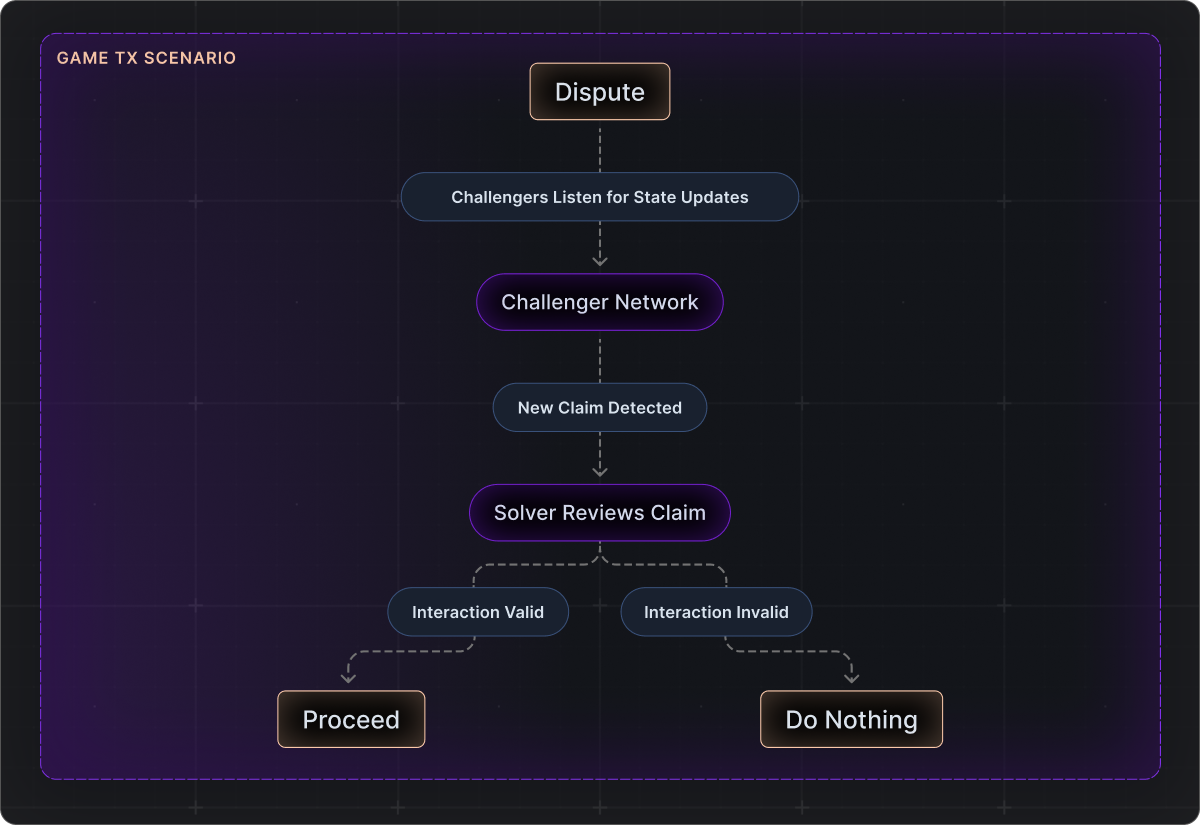
Challenges: The GR1D network utilizes a challenge mechanism to ensure the accuracy of information submitted by Circuit Nodes. These challenges involve verifying state transitions within the network.
Claiming Rewards: To claim rewards, Circuit Node operators must submit their CLC ID and the correct state root for a given challenge. The system verifies the validity of the CLC and the accuracy of the submitted information before distributing rewards.
Penalties: Incorrect submissions can lead to penalties, including temporary or permanent bans, as outlined in the "Banning Scenarios" section.
Circuit Node Statuses
Circuit Nodes can have one of the following statuses:
Checking: Actively performing verification tasks.
Ready: Prepared to receive new tasks.
Offline: Not operational due to network issues or maintenance.
Banned: Disqualified from earning rewards due to repeated failures or policy violations.
Pending: Awaiting approval for delegation.
The GR1D Network supports two native tokens, $GRID and xGRID. Both of these tokens serve to address a significant problem in web3 by creating robust incentives to hyper scale the ecosystem and enabling all stakeholders to participate in the value that they create through immutable digital ownership on a network underpinned by sustainable and scalable value creation.
GR1D Tokenomics
All insider tokens to Team, Advisors and Investors are locked for over 12months, with unlocks extending 48months from the token generation event (TGE).

At the core of GR1D’s L2 architecture are Optimistic Rollups, using GR1D’s custom-built Layer framework. We process transactions off-chain, batch them up, and post proofs back to Ethereum (L1), ensuring security while enhancing speed and efficiency. Here’s a closer look at how it all comes together:
GR1D’s Network operates under the assumption that all transactions are valid unless challenged. This optimizes for performance, drastically improving throughput while leveraging Ethereum’s security. Here’s the breakdown:
Off-Chain Execution: Transactions are processed off-chain in batches, slashing gas fees and minimizing the load on the Ethereum mainnet.
Batch Submissions: These transaction batches, accompanied by state roots, are periodically posted to Ethereum. This maintains transparency and ensures verifiability.
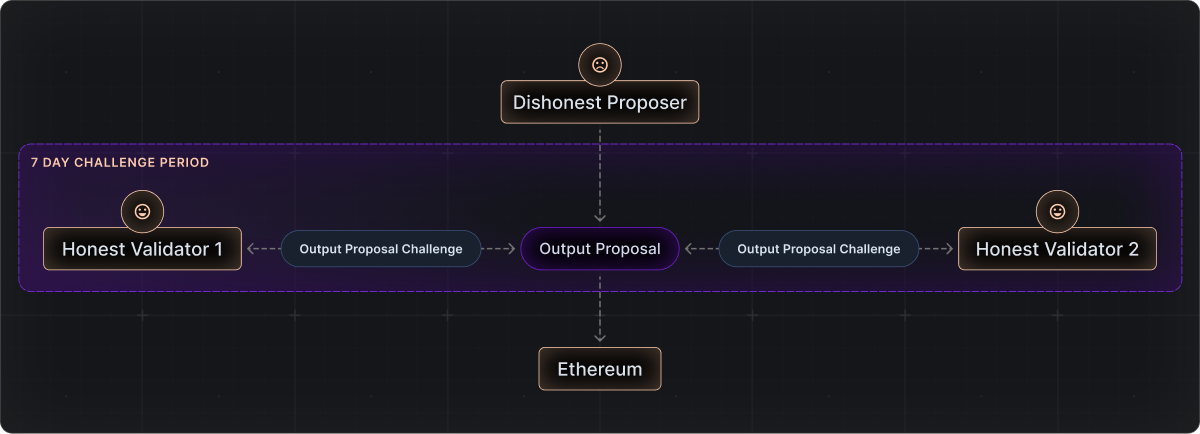
Challenge Period: GR1D provides a challenge window where participants can submit fraud proofs if they spot issues. It’s an effective mechanism to maintain network integrity and prevent malicious actions.
GR1D’s Layer architecture is built for flexibility, efficiency, and developer ease. Here’s how the main components work together:
Sequencer:
Transaction Manager: The Sequencer is the core element that manages transaction ordering, bundles them into blocks, and updates the off-chain state. It ensures minimal latency, providing a near-instant confirmation experience.
Batch Posting: The sequencer periodically posts these blocks as state roots to L1. This transparency ensures that the L2 state can be independently verified.
Fraud Proof Mechanism:
GR1D employs a fraud-proof system where transactions are assumed valid unless challenged within a specific period. This optimizes performance while maintaining security.
Challenge Window: Validators and other participants have a defined window to challenge any suspected fraudulent batch. If a fraud proof is valid, the disputed batch is reverted, ensuring the network’s integrity.
Scalable Throughput: GR1D’s off-chain transaction processing allows for massive throughput increases while minimizing the impact on Ethereum’s mainnet. This is crucial for gaming and dApps that require fast, high-volume transactions.
Cost Efficiency: Batching and compressing transactions allow GR1D to minimize gas fees, making operations like token transfers, asset exchanges, and game actions economical at scale.
Ethereum Compatibility: The GVM ensures that developers can deploy existing Ethereum dApps without any code modifications, providing flexibility and ease of integration with the broader Ethereum ecosystem.
The Data Availability (DA) Layer is a critical part of the GR1D architecture. It defines where the raw inputs (i.e., transaction data) for GR1D’s L2 blockchain are stored and accessed. The choice of DA module has a direct impact on the network's security and efficiency:
Ethereum DA:
GR1D uses Ethereum as its primary Data Availability Layer. By deriving source data from Ethereum’s infrastructure (including calldata, events, and data blobs), GR1D ensures high availability and security.
Reliability: Using Ethereum as the DA module guarantees that as long as Ethereum remains accessible, GR1D’s L2 data remains verifiable. This provides robust protection against data loss or manipulation, which is crucial for syncing the chain and maintaining the integrity of the network.
GR1D’s governance framework ensures that network upgrades, configurations, and decision-making processes are handled transparently and efficiently. Here’s how governance operates within the GR1D ecosystem:
MultiSig Contracts:
GR1D utilizes MultiSig Contracts to manage critical upgrades and configuration changes. MultiSig Contracts require a predefined number of signatures from trusted participants before executing actions, ensuring that no single entity can unilaterally alter the system.
Security Measures: The security of these MultiSig systems depends on the number of participants and their safety protocols. By using robust MultiSig setups, GR1D enhances the decentralization and security of network management.
State Proposer:
State Commitment Posting: This component submits the L2 state root to Ethereum, ensuring the L2 state remains verifiable and secure. It also guarantees data availability for all participants.
Ensuring Data Integrity: By committing state updates to L1, the State Proposer makes sure that all off-chain transactions can be audited transparently, maintaining the integrity of the system.
Data Batcher:
Data Compression: The Data Batcher compresses transaction data before posting it to Ethereum, ensuring efficient use of gas and block space.
Integration with Ethereum: Compressed batches are periodically sent to Ethereum, leveraging its security while allowing GR1D’s L2 to maximize scalability and efficiency.
Security Tied to Ethereum:
Ethereum as the Security Backbone: By leveraging Ethereum as the base layer, GR1D inherits Ethereum’s robust security features. Posting state roots on L1 ensures that the rollup’s transactions are cryptographically verifiable.
Community-Driven Verification: Validators can independently audit the submitted state roots and batches, and any participant can submit fraud proofs, reinforcing the decentralized nature of the network.
If data becomes inaccessible or corrupted within the DA Layer, it could prevent the chain from syncing correctly. That’s why choosing a reliable and secure DA module, like Ethereum’s, is essential for maintaining the health of the GR1D ecosystem.
Governance Tokens are issued within the GR1D network to decentralize decision-making. Token holders can vote directly on various proposals or delegate their voting power to others, influencing key aspects like network upgrades, fee structures, and strategic partnerships.
Community Control: This token-based governance system empowers the community to participate actively in the direction and growth of the GR1D ecosystem, ensuring that the network remains adaptable and developer-focused.
Fire up MetaMask and go to the network dropdown.
Click "Add Network" and fill in the following details:
Network Name: GR1D Testnet
New RPC URL:
Chain ID: 123420000418
Currency Symbol: ETH (we’re using Sepolia ETH here)
Save it, and boom—you’re connected to the GR1D Testnet via MetaMask.
Block Explorer URL: https://blockscout-123420000418.raas-testnet.gelato.digital/
Alright, welcome to the GR1D Testnet! If you’re looking to get hands-on with GR1D’s L2 solution, you’re in the right place. Whether you’re deploying smart contracts, testing cross-chain functionality, or simply exploring the GR1D environment, this guide will get you connected and building in no time.
First things first—you’ll want to set up your development environment to interact with the GR1D Testnet. If you’re familiar with tools like MetaMask, Hardhat, or Truffle, you’re already halfway there. Here’s the lowdown:
Fire up MetaMask and go to the network dropdown.
Click "Add Network" and fill in the following details:
Network Name: GR1D Testnet
New RPC URL: https://rpc-123420000418.raas-testnet.gelato.digital
Chain ID: 123420000418
Currency Symbol: ETH (we’re using Sepolia ETH here)
Block Explorer URL:
Save it, and boom—you’re connected to the GR1D Testnet via MetaMask.
Now, for the real fun—getting your smart contracts ready. We’ll set up either Hardhat or Truffle to deploy on the GR1D Testnet.
Hardhat Configuration
In your hardhat.config.js, plug in the following:
To deploy your contracts:
Truffle Configuration
Update your truffle-config.js to include:
Deploy with:
Got your contracts deployed? Need to debug a transaction? Head over to the GR1D Testnet Explorer.
It’s your go-to for viewing transactions, inspecting smart contracts, and seeing token transfers in action. If something doesn’t look right, this is where you’ll find the details.
For those wanting real-time updates, you can connect via the WebSocket endpoint:
WSS URL: wss://ws-123420000418.raas-testnet.gelato.digital Perfect for monitoring on-chain events or listening for contract events like NFT mints or DeFi protocol actions.
Ready to test out cross-chain functionality? Let’s bridge some assets between Sepolia (L1) and the GR1D Testnet (L2). It’s all done through the GR1D Testnet Bridge. Here’s how you do it:
Connect MetaMask to the Sepolia testnet.
Set up the bridge with:
Source: Sepolia Testnet (L1)
Destination: GR1D Testnet (L2)
Choose your asset (e.g., Sepolia ETH or any ERC-20 deployed there).
Enter the amount and confirm the transaction.
Sign in MetaMask and let the bridge do its thing. You should see the assets on GR1D Testnet in a few minutes.
Let’s get your smart contracts live on the GR1D Testnet. It’s straightforward if you’ve deployed on Ethereum before—same tooling, just a different network.
Make sure your Solidity version matches the one set in your Hardhat/Truffle config (I recommend 0.8.26).
With Hardhat:
With Truffle:
Check the GR1D Testnet Explorer to make sure everything’s in place. You’ll be able to see transaction details, contract interactions, and token transfers—perfect for debugging and validating your deployments.
GR1D’s architecture links L1 (Sepolia) and L2 (GR1D Testnet), and you might want to interact with the key contracts:
Batcher on L1: Batcher Contract This handles batching transactions and syncing state between L1 and L2.
Proposer on L1: Proposer Contract Submits state roots and keeps everything consistent between the GR1D Testnet and Sepolia.
Use a Test Wallet: Always keep a separate wallet for testnet activity. Keeps things tidy and avoids accidental mainnet confusion.
Test Everything: The GR1D Testnet is built for experimentation. Push the limits—bridge assets, deploy contracts, and simulate real-world scenarios.
Use the Explorer: Don’t skip the GR1D Testnet Explorer. It’s your best friend for transaction logs, contract validation, and debugging.
module.exports = {
networks: {
gr1dTestnet: {
url: "https://rpc-123420000418.raas-testnet.gelato.digital",
accounts: [`0x${YOUR_PRIVATE_KEY}`], // Replace with your private key, keep it safe!
chainId: 123420000418,
gas: "auto",
gasPrice: "auto",
},
},
solidity: "0.8.26", // Make sure this matches your contracts
};npx hardhat run scripts/deploy.js --network gr1dTestnetmodule.exports = {
networks: {
gr1dTestnet: {
provider: () => new HDWalletProvider("YOUR_MNEMONIC", "https://rpc-123420000418.raas-testnet.gelato.digital"),
network_id: 123420000418, // GR1D Testnet Chain ID
gas: 3000000, // Adjust this based on your contract's requirements
gasPrice: 20000000000, // 20 gwei; tweak as needed
},
},
compilers: {
solc: {
version: "0.8.26",
},
},
};truffle migrate --network gr1dTestnetnpx hardhat compilenpx hardhat run scripts/deploy.js --network gr1dTestnettruffle compiletruffle migrate --network gr1dTestnet


The Ethereum Asset Verification API allows developers to verify whether a user holds specific assets on the Ethereum mainnet, including ERC20 tokens and NFTs (ERC721). This API is crucial for integrating asset verification into decentralized applications (dApps) and services built on Ethereum, enabling secure and reliable checks for asset ownership directly on the Ethereum blockchain.
Asset Verification API
This API allows you to verify if a user holds a specific asset on the Ethereum mainnet, including ERC20 and ERC721 tokens.
Endpoint:
Headers:
Authorization: <GR1D_API_KEY> (Contact [email protected] to get early access)
Content-Type: application/json
Request Body:
user_address: The Ethereum address of the user whose asset holdings are being verified.
contract_address: The address of the ERC20 or ERC721 contract.
Sample Response:
status: HTTP status code (200 indicates success).
message: A message indicating the result of the query.
data:
Error Handling
In the event of an error, the API will return a response with the appropriate HTTP status code and an error message. Common error codes include:
400: Bad Request - The request parameters are invalid.
401: Unauthorized - The GR1D_API_KEY is missing or invalid.
404: Not Found - The specified contract_address or user_address is invalid.
Security Considerations
API Key Management: Ensure that the GR1D_API_KEY is kept secure and never exposed in client-side code or public repositories.
Data Integrity: The query results are signed by Wormhole guardians, ensuring data integrity across chains.
Rate Limiting: Be aware of any rate limits imposed on the API to prevent abuse and ensure fair usage.
Examples and Edge Cases
ERC20 Token Verification:
Expected response: The balance field will indicate the number of ERC20 tokens held by the user.
ERC721 Token Verification:
Expected response: The balance field will indicate the number of ERC721 tokens (or assets) held by the user.
POST https://alpha.gr1d.network/api/ccq-evmuser_address: The Ethereum address queried.
asset.balance: The number of tokens the user holds.
asset.QueryResult: A hexadecimal string representing the encoded query result.
500: Internal Server Error - An unexpected error occurred on the server.
Expected response: The balance field will be 0, and the QueryResult will reflect that no assets were found.
{
"user_address": "0x29469395eaf6f95920e59f858042f0e28d98a20b",
"contract_address": "0xbc4ca0eda7647a8ab7c2061c2e118a18a936f13d"
}{
"status": 200,
"message": "Assets Fetched Successfully",
"data": {
"user_address": "0x29469395eaf6f95920e59f858042f0e28d98a20b",
"asset": {
"balance": 183,
"QueryResult": "0x00000000000000000000000000000000000000000000000000000000000000b7"
}
}
}{
"user_address": "0x1234567890abcdef1234567890abcdef12345678",
"contract_address": "0xabcdefabcdefabcdefabcdefabcdefabcdefabcdef"
}{
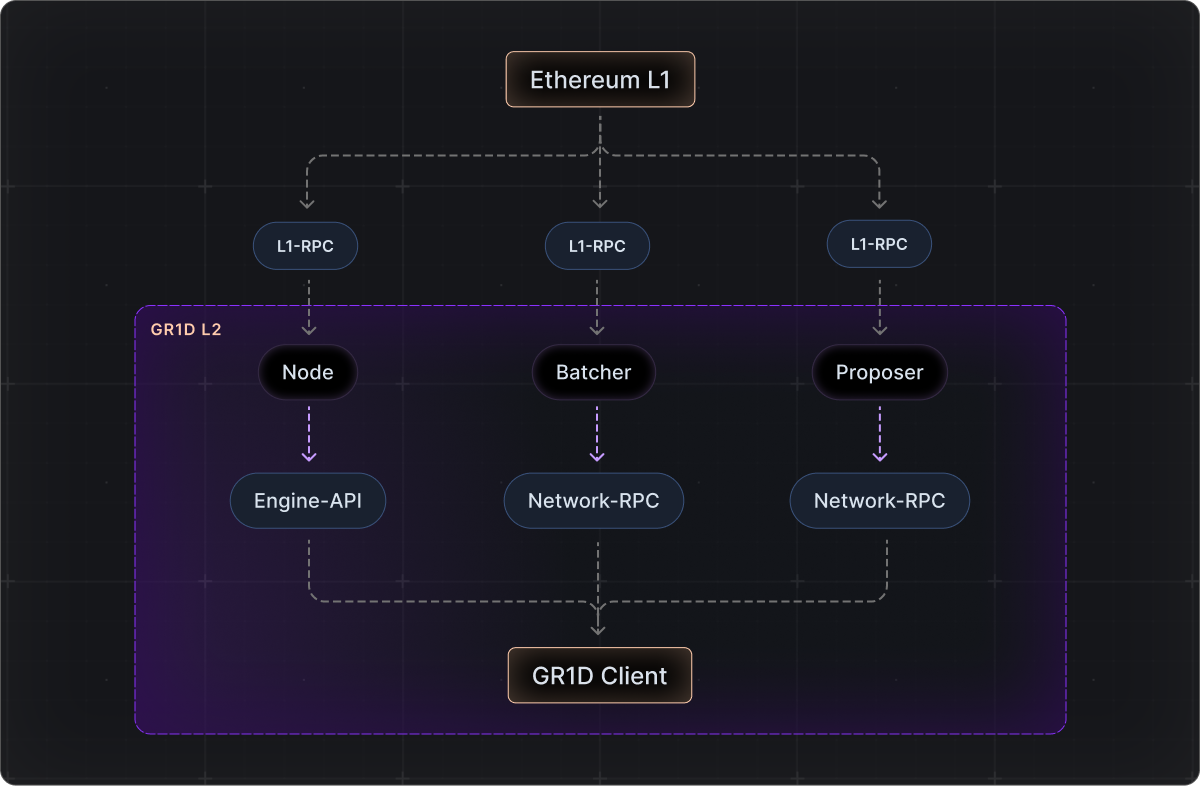
"user_address": "0x1234567890abcdef1234567890abcdef12345678",
"contract_address": "0xabcdefabcdefabcdefabcdefabcdefabcdefabcdef"
}{
"user_address": "0x1234567890abcdef1234567890abcdef12345678",
"contract_address": "0xabcdefabcdefabcdefabcdefabcdefabcdefabcdef"
}